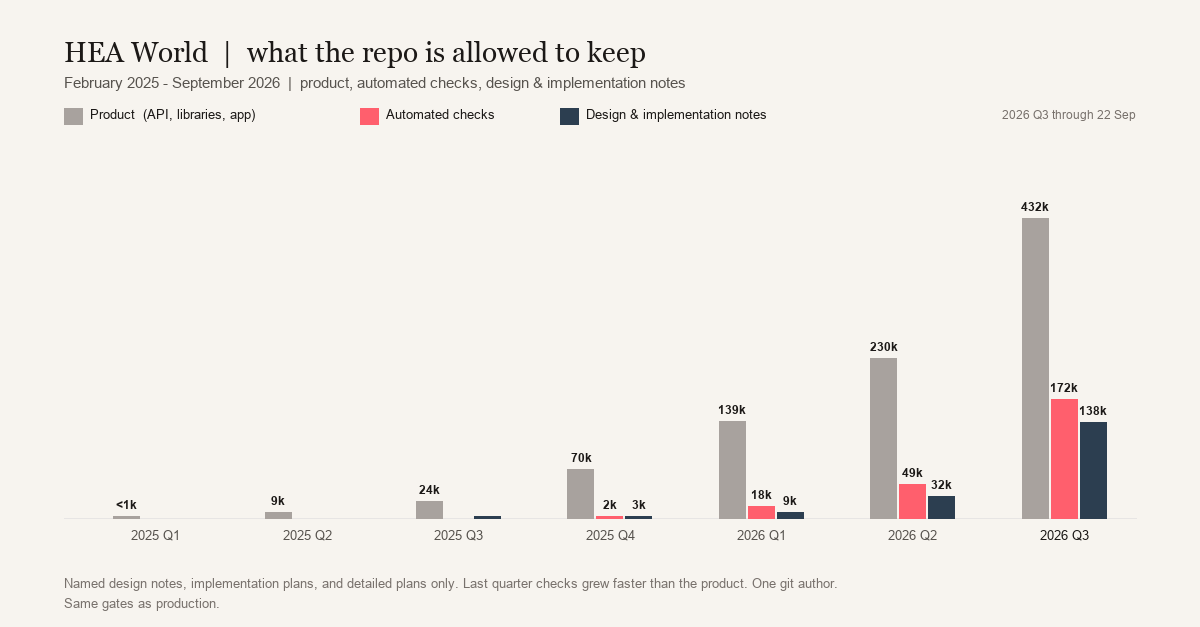
I think I’ve been given a superpower.
And the real question isn’t whether it’s powerful, but where to apply it.
I’ve been building HEA-World with AI since GPT-3. I’ve seen the evolution:
GPT-4, GPT-5, 5.2. Each wave increased productivity.
But with Codex and GPT-5.3, it crossed a threshold.
Something fundamental shifted.
For most of my career, I worked like a conductor.
I aligned product, engineering, UX, finance, and operations.
My role was orchestration: turning vision into execution through teams.
Now it feels like moving from conducting the orchestra
to composing, arranging, and conducting the entire symphony yourself.
Architecture and system design. Implementation and refactoring.
Governance layers and guardrails. UI adjustments and product polish.
Documentation and operational playbooks. Business modeling.
Deployment and release loops.
From idea to production in one continuous flow.
This isn’t incremental productivity.
It is a collapse of layers between intent and execution.
But AI does not solve everything.
Product–market fit remains the golden gate.
AI does not invent real customer pain, fix weak positioning,
create distribution, or replace timing and discipline.
AI amplifies execution. It does not replace judgment.
When execution becomes cheap, focus becomes expensive.
You can build ten things at once, chase trends, and ship endlessly.
But leverage without focus becomes noise.
That is why I believe HEA-World deserves this moment.
Because what I am experiencing as a builder is what organizations are starting to face:
the barrier is no longer “can we build it?”
The barrier becomes “can we deploy it safely, consistently, and on-brand?”
AI answers questions.
Human-Enhanced Agents represent organizations.
That difference matters.
As execution power becomes widespread, governance becomes strategic.
Control layers, content boundaries, auditability, and operational reliability
stop being nice to have.
They become the product.
#AI #Founders #ProductMarketFit #HumanEnhancedAI #GovernedAI
#AIEngineering #Startups #HEAWorld