
For decades, websites have been organized around navigation: homepages, menus, landing pages, forms, and search bars. That structure still matters, but it asks visitors to do a lot of work before they get value.
A Human-Enhanced Agent changes the first interaction. It lets a visitor ask what they came to ask, then uses your own knowledge, tone, and rules to answer in a way that still represents the organization.
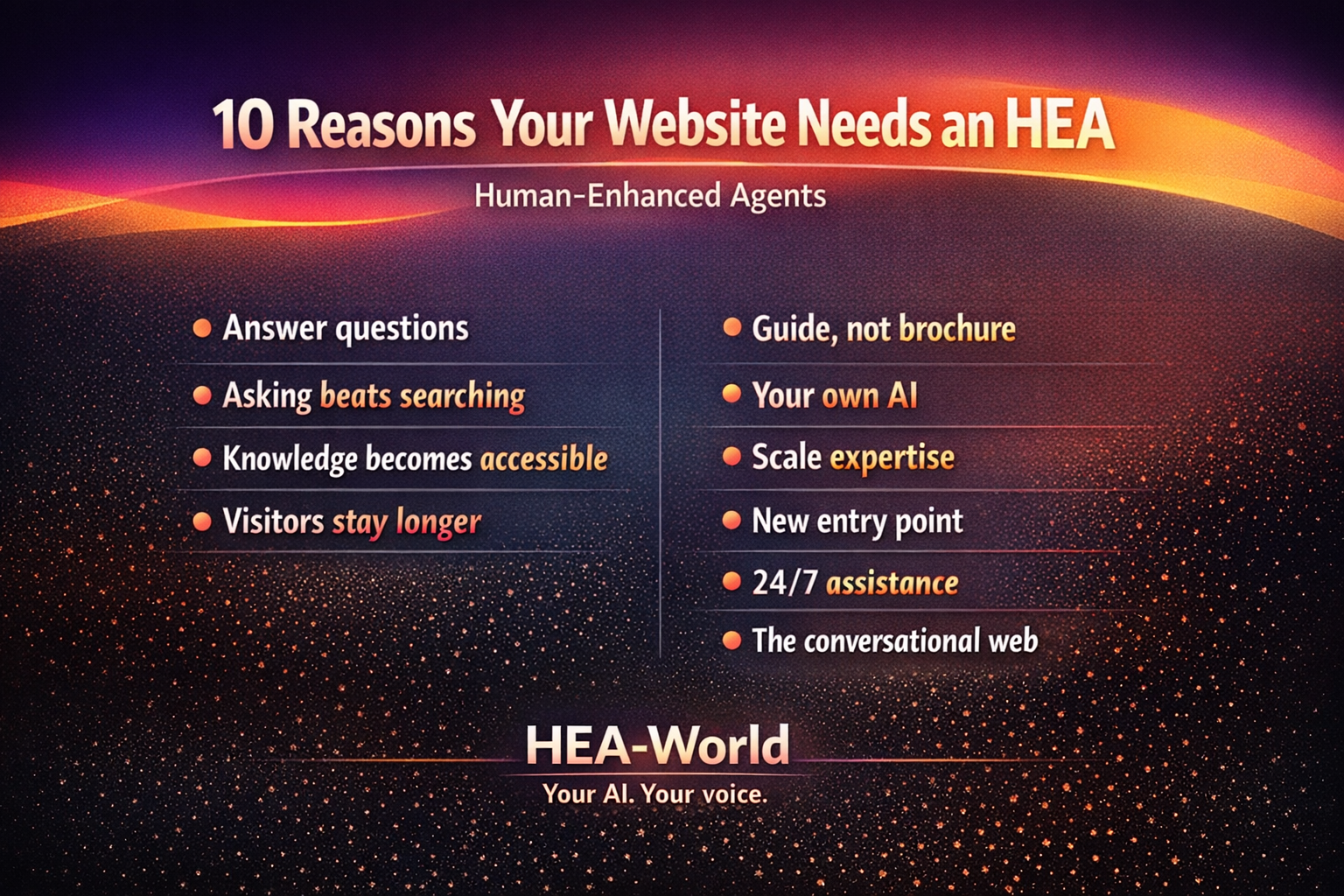
1. Your website can finally answer questions
Most websites publish information. An HEA turns that information into answers. The visitor does not need to know whether the answer lives in pricing, FAQ, docs, a product page, or a PDF. The agent can respond directly and point back to the right source.
2. People prefer asking over searching
Menus require visitors to understand your internal structure. Search bars require the right keywords. A conversational agent lets people start with their own words, which is usually closer to how decisions are actually made.
3. Your expertise becomes accessible
Small teams often have excellent knowledge spread across blogs, decks, case studies, policies, and support answers. An HEA makes that expertise easier to reach, especially for visitors who would never read every page.
4. Visitors stay engaged longer
When a visitor receives a relevant answer quickly, the next question becomes natural. The conversation can move from curiosity to comparison, from comparison to trust, and from trust to a clear next step.
5. You provide guidance, not just information
A static page can explain what exists. A Human-Enhanced Agent can help someone understand what applies to their situation. That makes the experience feel closer to a good advisor than a brochure.
6. Your knowledge becomes your own AI
Generic AI assistants are useful, but they do not automatically know your edge cases, values, services, pricing assumptions, proof, and preferred language. An HEA is shaped by what you choose to expose and how you want it represented.
Your knowledge should not disappear into a generic AI ecosystem. It should become your own conversational interface.
7. It scales repeated explanations
Many organizations answer the same questions through email, forms, sales calls, and support tickets. An HEA can handle a meaningful portion of those explanations instantly while preserving human escalation for the conversations that deserve it.
8. It creates a new entry point to the organization
Websites usually offer pages and contact forms. An HEA offers a third path: ask first, then decide. That path is especially useful for visitors who are interested but not ready to fill in a form.
9. It works when your team is offline
Small teams cannot be available in every time zone. A grounded website agent can answer common questions immediately and capture enough context for a human to continue later without starting from zero.
10. The web is becoming conversational
Search engines, AI answer engines, and business software are all moving toward natural-language interaction. The website is next. The question is not whether visitors will expect conversation, but whether your organization will own that conversation or leave it to generic systems.
The next layer of the website
The point is not to replace every page. Pages still provide structure, proof, and durable reference. The point is to add a layer that helps people use that structure without getting lost.
Start with a clear HEA trained on your real public knowledge. Then add governed skills when the conversation should qualify a lead, collect a support request, recommend a resource, or hand off to a person.