
We ask questions. We expect immediate answers. We want help finding the right product, understanding a service, solving a problem, or deciding what to do next.
At HEA-World, we believe these interactions will increasingly happen through AI agents.
But we also believe that AI should not replace the knowledge, identity, and judgement of the humans and organisations behind it.
This is why we call our AI agents Human-Enhanced Agents — or HEAs.
What is an HEA?
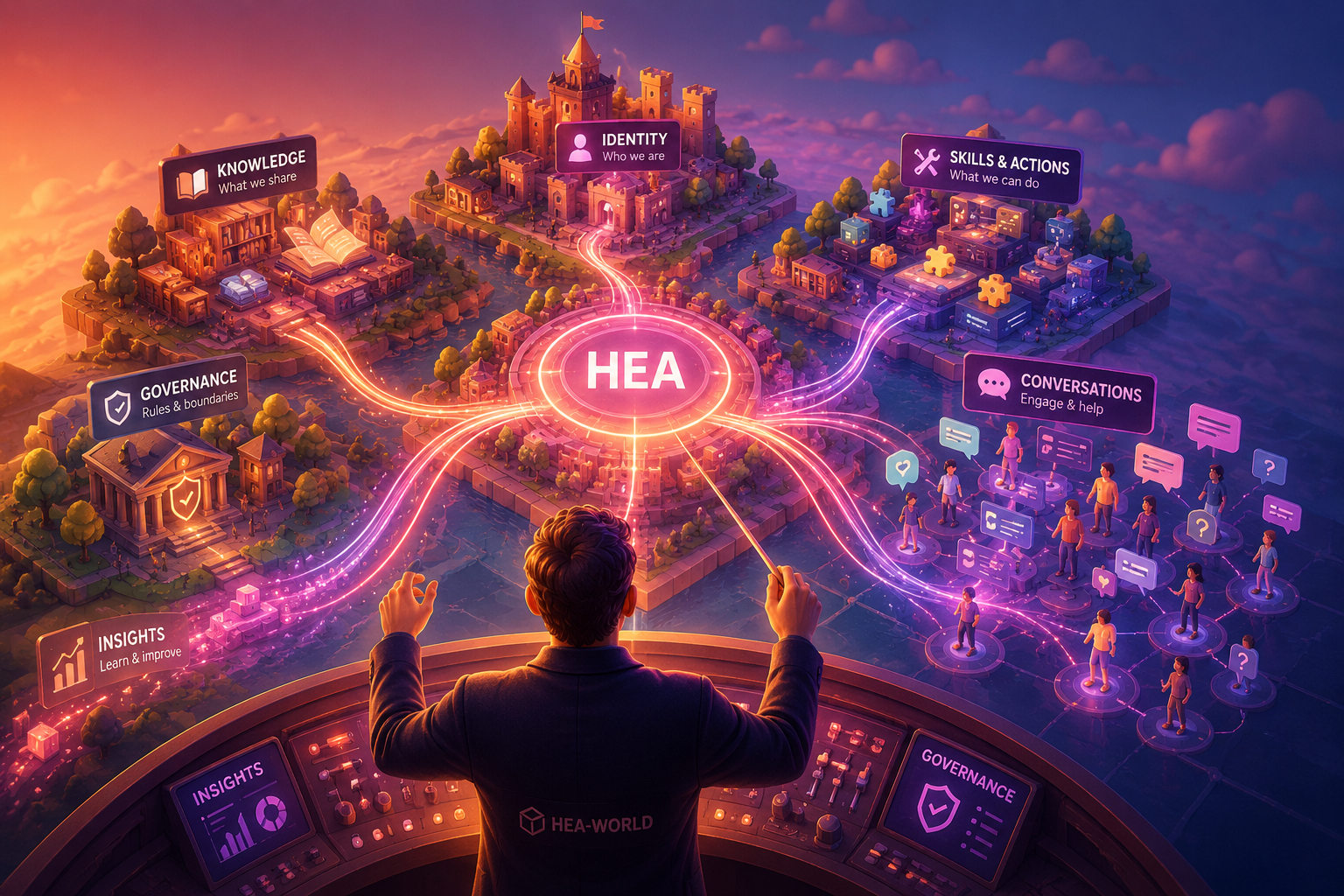
A Human-Enhanced Agent (HEA) is an AI agent created, grounded, and governed by a human, team, brand, or organisation.
An HEA combines the capabilities of modern artificial intelligence with the knowledge, identity, content, services, and rules defined by its owner.
Unlike a generic AI assistant, an HEA is designed to represent a specific organisation or purpose.
- It knows what it has been taught.
- It uses the resources made available to it.
- It communicates according to a defined personality and voice.
- And when it is allowed to take actions, those actions operate within explicit skills, permissions, and governance rules.
The AI provides intelligence. Humans provide identity, knowledge, purpose, and control.
Why "Human-Enhanced" rather than "Artificial Intelligence"?
The term artificial intelligence naturally focuses on the machine.
We wanted to start from a different perspective.
Behind every business, school, association, public organisation, or brand are people with knowledge and experience. They know their customers. They understand their products and services. They have a history, a culture, a way of communicating, and often years of accumulated knowledge.
An HEA is designed to extend this human and organisational intelligence.
The human is not an afterthought or simply a supervisor correcting the AI when something goes wrong. The human is part of the architecture.
People decide what the HEA should know, how it should behave, which resources it can use, and which actions it is allowed to perform.
This is the meaning of Human-Enhanced.
An HEA is more than a chatbot
Chatbots have traditionally been built around predefined flows, frequently asked questions, or support scripts.
An HEA is different.
It can understand natural conversations, reason across information, adapt to the context of a question, and use approved capabilities to help a visitor move forward.
For example, an HEA could:
- answer questions using an organisation's own knowledge;
- explain products or services;
- help a prospect identify the right solution;
- capture and qualify customer intent;
- guide a visitor towards the right person or next step;
- create a support request;
- help nurture an existing customer relationship;
- operate across a website, email, WhatsApp, or other channels;
- use governed skills and tools to perform approved actions.
The objective is not simply to answer more questions. The objective is to create a useful digital representative of the organisation.
Grounded in your knowledge
A generic AI model knows a great deal about the world. But it does not automatically know your organisation like you do.
An HEA is grounded in resources provided or approved by its owner. These can include website content, documents, product information, service descriptions, policies, articles, and other organisational knowledge.
This grounding helps the HEA answer from the perspective of the organisation it represents.
The organisation remains responsible for deciding which knowledge should shape its HEA. As the organisation evolves, its HEA can evolve with it.
Built from the outside in
HEAs are built from the outside in.
Most organisations have spent years creating and refining the information they present to the outside world: their website, mission, services, products, articles, policies, and public resources.
This content is rarely accidental. It has been written, reviewed, curated, and shaped to explain who the organisation is, what it does, and how it wants to be understood by customers, partners, and the wider world.
We believe this curated public knowledge is the most natural and suitable starting context for an AI designed to interact with visitors.
Instead of starting with unrestricted access to internal systems and asking an AI to determine what it should or should not reveal, an HEA first learns from the knowledge the organisation has already chosen to make public.
This creates a safer and more intentional foundation for customer-facing AI.
But the value of this context goes further. By understanding an organisation's mission, services, products, language, and public identity, an HEA develops a unique awareness of the organisation it represents.
This organisational context can then support AI systems used for automation and productivity improvement. The HEA already understands the organisation before it is given additional skills, tools, or access to internal systems.
Over time, more knowledge and capabilities can be added deliberately and governed according to their purpose and sensitivity.
Start with what the organisation wants the world to know. Then build intelligence and capabilities inward from there. This is what we mean when we say that HEAs are built from the outside in.
An HEA evolves with the organisation
Organisations are not static.
Their services change. New products are introduced. Teams learn. Strategies evolve. New articles are published, policies are updated, and the way an organisation presents itself to the world changes over time.
An HEA should evolve with them.
HEAs are continuously refreshed to reflect changes in the organisation's knowledge and public content. As the organisation updates the information it shares with the outside world, this evolving context can become part of the knowledge available to its HEA.
But the relationship also works in the other direction.
Every conversation with visitors, prospects, and customers can reveal something about how the organisation is perceived and understood.
- What questions are people repeatedly asking?
- Which services are difficult to understand?
- What information are visitors unable to find?
- What concerns appear before a purchase or decision?
- What topics are becoming more important?
HEAs can turn these conversations into insights for the humans who lead and improve the organisation. Those insights can help teams refine their content, clarify their services, improve customer experiences, identify new needs, and make better decisions.
The organisation improves its HEA. And the HEA helps the organisation improve.
This creates a continuous learning loop between human knowledge, organisational content, AI interactions, and real-world customer signals.
The HEA is therefore not a static digital representation of an organisation. It is a living extension of an organisation that evolves alongside the people who lead it.
Governed by humans
Giving AI more capabilities also creates a need for stronger governance.
An AI agent that can only answer a question has limited operational impact. An AI agent that can send an email, create a support request, update customer information, book an appointment, or interact with another system is much more powerful.
HEA-World separates AI reasoning from governance.
The AI may understand what a person is asking and determine that a particular skill could help. But permissions, confirmations, and execution rules remain governed by the platform and the organisation.
We believe this distinction will become increasingly important as AI agents move from answering questions to performing actions.
AI may interpret. AI should not own safety and governance.
Your HEA can become part of the team
We see AI agents becoming a new interface between organisations and the people they serve.
Today, a website often asks visitors to navigate pages, menus, search boxes, and forms. Tomorrow, many visitors will simply start a conversation. They will explain what they need and expect the organisation to respond intelligently.
An HEA can become the conversational layer of an organisation: available to answer, guide, listen, and help.
But it remains connected to the human team behind it. People can improve its knowledge, define its skills, monitor conversations, understand customer questions, and decide how the HEA should evolve.
This is why we sometimes describe an HEA as becoming part of the team. Not as a replacement for the team. As an extension of it.
Who owns an HEA?
We believe organisations should be able to build and control their own customer-facing AI.
Your knowledge matters. Your identity matters. Your customer relationships matter.
The AI representing your organisation should therefore be grounded in your resources and governed according to your rules.
HEA-World provides the platform to create, manage, govern, and deploy Human-Enhanced Agents.
The underlying AI models will continue to improve. New models will appear. Capabilities will evolve. AI will become faster, more multimodal, and increasingly agentic.
But the organisation's identity, knowledge, relationships, and governance should remain its own.
The idea behind HEA-World
HEA-World was created around a simple belief:
Every organisation should be able to create and control its own AI.
Not only large companies with dedicated AI engineering teams. Small and medium-sized businesses, schools, associations, public organisations, and independent professionals should also be able to participate in the transition towards conversational and agentic AI.
We call the AI agents they create Human-Enhanced Agents.
Or simply: HEAs.