
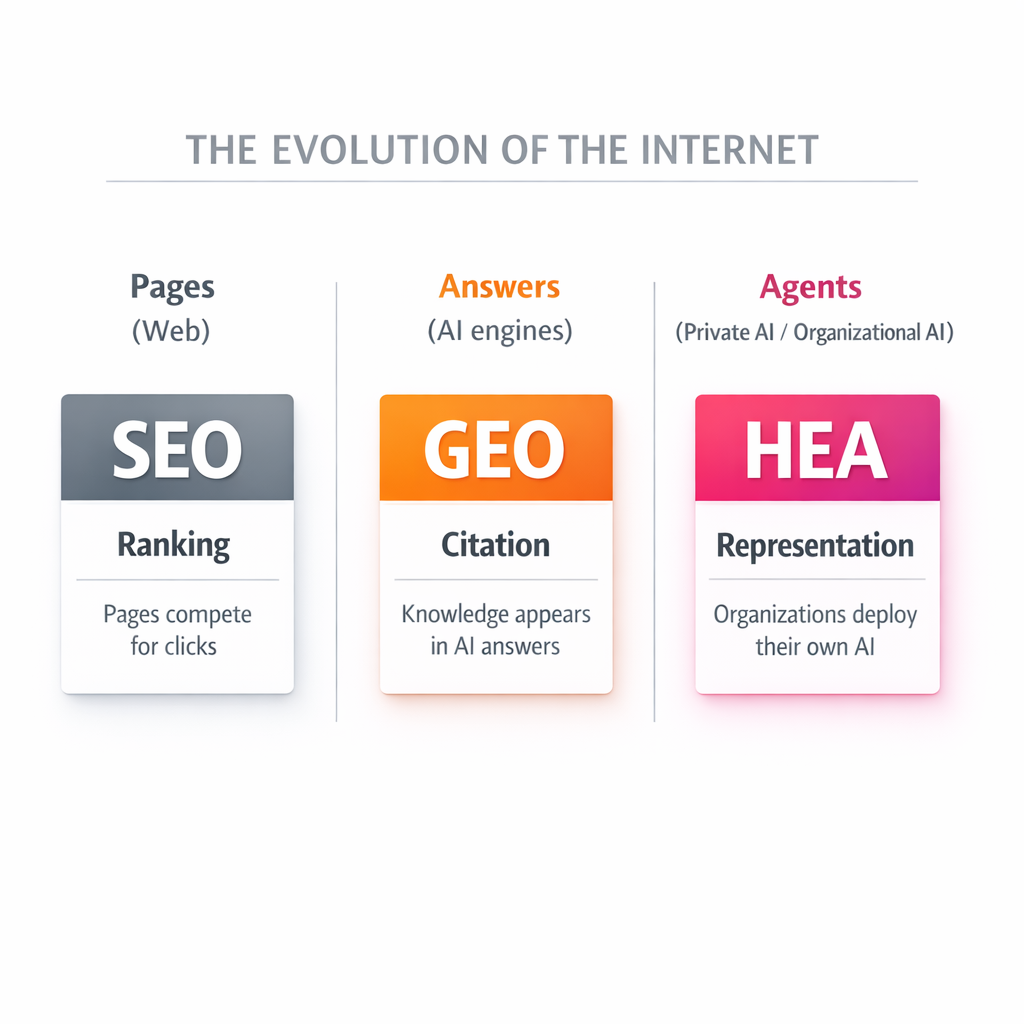
The next interface is not another page
Every organization eventually needed a website because the web became the default place to be found. The next shift is similar, but more direct: people increasingly expect to ask questions and receive guidance instead of browsing a structure first.
That expectation will not stop at software companies. Schools, charities, clinics, agencies, municipalities, creators, and local businesses all have knowledge people need to use.
Organizations need owned representation
If an organization does not provide its own agent, other systems will summarize it anyway. Search engines, generic assistants, comparison sites, social platforms, and third-party tools will all become interpreters of organizational knowledge.
An owned AI agent gives the organization a direct representative: one that can be grounded in approved content, updated when policies change, and reviewed when answers fail.
The agent will do jobs the website does poorly
- Answer: turn scattered content into direct responses.
- Guide: help people choose the right service, product, or resource.
- Qualify: collect context before a human conversation.
- Route: send people to the right team, form, file, or page.
- Hand off: preserve conversation context for humans.
This does not replace the organization
The strongest agent strategy is not "replace humans." It is "make human knowledge easier to reach." A good agent handles repetitive explanation, answers common questions, and prepares better handoffs. Humans still own judgment, relationships, sensitive cases, and accountability.
There will be many agents, but one public agent matters first
Large organizations will eventually have many agents: service agents, sales agents, onboarding agents, HR agents, partner agents, and internal policy agents. But the public website agent is often the first one that matters because it affects discovery, trust, and the first impression.
That public agent should be treated like an official surface, not an experiment hidden in a corner.
The HEA pattern keeps the organization present
A Human-Enhanced Agent is useful here because it does not start with autonomy. It starts with human-owned knowledge, voice, skills, and review. The goal is not for the agent to act wildly. The goal is for it to represent the organization faithfully.
The future organization will not only have a homepage. It will have a conversational front door.
How to prepare now
- Clean up your public knowledge: services, pricing assumptions, FAQs, proof, policies, and contact paths.
- Decide what your agent can answer and what it must hand off.
- Test with real visitor questions, not only happy-path demos.
- Review conversations so missing knowledge becomes a publishing roadmap.
- Add skills only when the trust boundary is clear.